Kcell & Activ
The launch of KCell/Activ's super-app fundamentally transformed their customer
service approach. This project, driven by our enhanced UX design including efficient wireframes and improved app architecture, successfully halved the call center usage.
This transition not only boosted operational efficiency but also maintained high-quality
customer service during the challenging times of COVID-19, thereby setting a new
benchmark in telecommunication services.

Overview
Kcell (KCEL) is one of the biggest telecom companies in Kazakhstan.
It provides cellular services under the brands of Kcell (7+ million clients) and Activ (8+million clients). Both brands provide almost identical number of services, like:
Core telecommunication services: calls, sms, mobile internet, roaming, eSim
Financial tools: payments, transfers (from/to customer, bank cards, bank accounts), withdrawal
Marketplace: contract phones, gadgets, home appliances
Our company was presented by me and my business partner Almas Tuyakbayev. There was no strict task separation between us two, however, personally, I was responsible for the insight gathering, information architecture, wireframing and prototyping. Presenting was on both of us. We collaborated with Azimut Labs (tech implementation) and Aidash studio (visual design). It was required to complete our part in around two months, and our task was to define the main issues, offer a concept and deliver design artifacts, such as sitemaps, wireframes and prototypes.
Problem
Back then, Kcell and Activ had all the digital products and services inconsistently distributed on the web, app stores, and offline. Thus there were many complaints from the clients about the entire service and each app/website. Moreover KCell/Activ faced a significant challenge in managing high call center traffic, which led to operational inefficiencies and impacted customer satisfaction.


Another challenge was to define all the problems and potential solutions during the COVID lockdown in our city.
Research
To identify the problems and challenges, we started with information gathering from the stakeholders by meeting with each department, including Core, MFS, Call-center, Roaming, and Marketing. All the meetings were held online via Zoom.


To learn more about the users' pain points and needs, we gathered information from multiple sources: call-center complaints (past and present), web/app analytics, research on the usability of current apps/sites, and marketing, as well as the research papers and reports, such as McKinsey's report on telecommunication technologies, a similar report by Bain&Company and others.


Moreover, we collected and analyzed top telecom companies' websites and mobile apps, as well as the apps of other relevant products, and made a competitive analysis.


Ideation
According to research insights and ideation process, we stated:
Users are waiting for an all-in-one type of experience. Thus, we can reach this by introducing the concept of a super-app (according to the research results and our observations)
To make it omnichannel or, in other words, consistent among different platforms, it must be mobile-first (web analytics gave us an incredible 92% of visitors who use mobile devices for visiting the website)
Moreover, we have developed new ideas and concepts for each department based on best practices and research recommendations.
So, we offered our vision to the stakeholders, and after some discussions, we agreed on the concept we stated above.
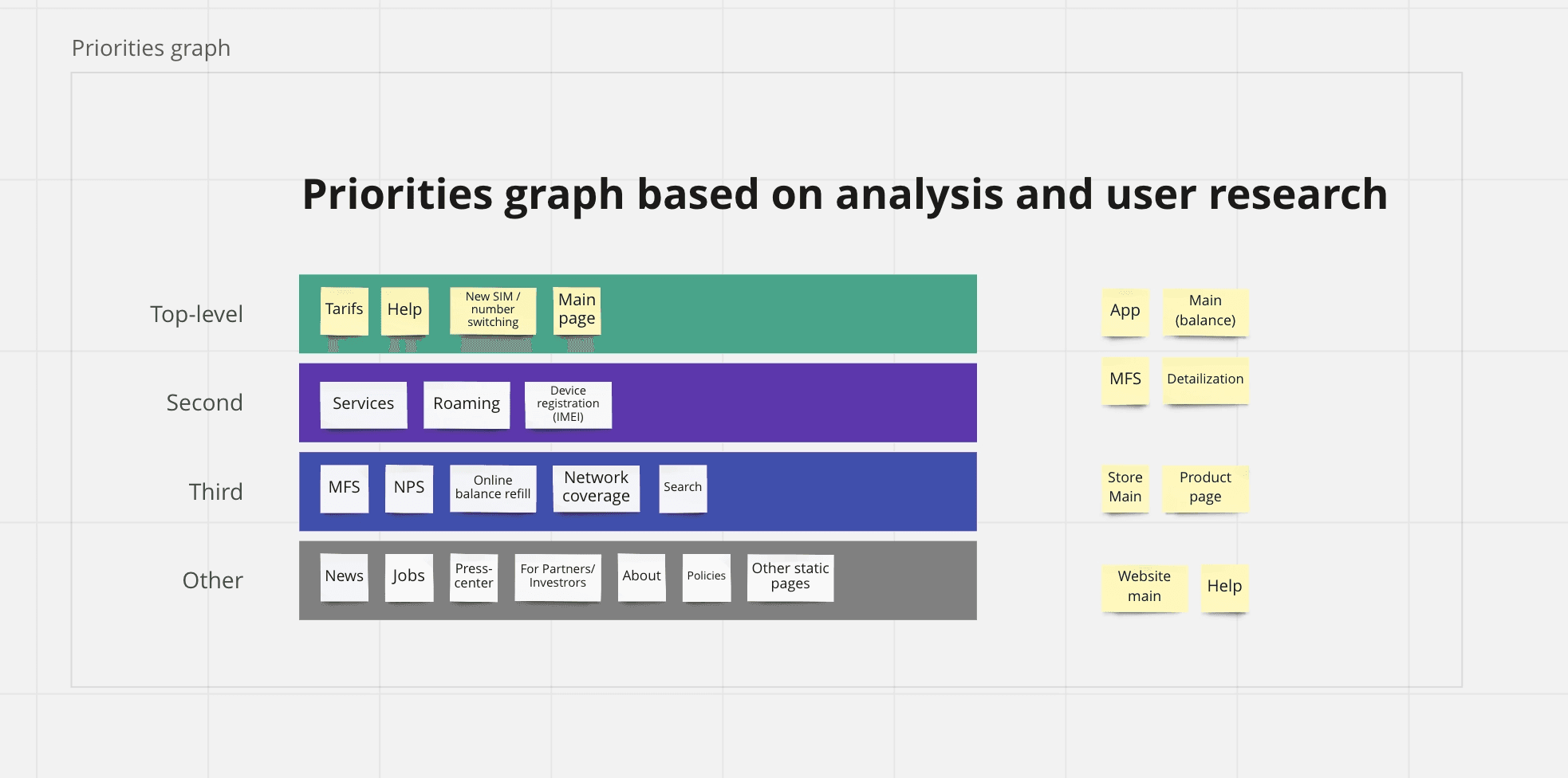

In collaboration with the stakeholders and the business analytics of Azimut Labs, we created user stories for each use-case. Each user story was agreed and properly documented.

Next, we structured the Information Architecture, including sitemaps and user flows.


We made several iterations with all the departments (both separate and collectively) and determined the best structure for the future app.


